More colours and textures that have caught my eye. Getting trigger-happy!

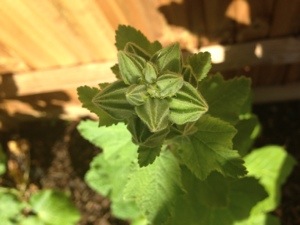


More colours and textures that have caught my eye. Getting trigger-happy!
Stripes


I can’t believe it! So, so happy to announce that Kaava has reached #15 on the ravelry Hot Right Now list! Out of 127,977!

This is a huge “designer moment” for me, I thought I was at least 20 more patterns away from making “the list”. Seriously guys, happy, happy, happy dancing going on here.
Half the reason I don’t post as often as I should is that I feel like I must have pics every time I do. That’s another of the “golden rules” of blogging. 1) Post often, 2) Have pics 3) Be interesting. 3)’s kinda optional.
Of late, I’ve been working on a secret design for Knit Now 27; getting submissions together – can’t show you any pics of them either for much the same reason, and I have two designs in testing at the mo too. One of those (le sigh) is also secret, but the other is the Kaava Shawlette that I flashed the other day.
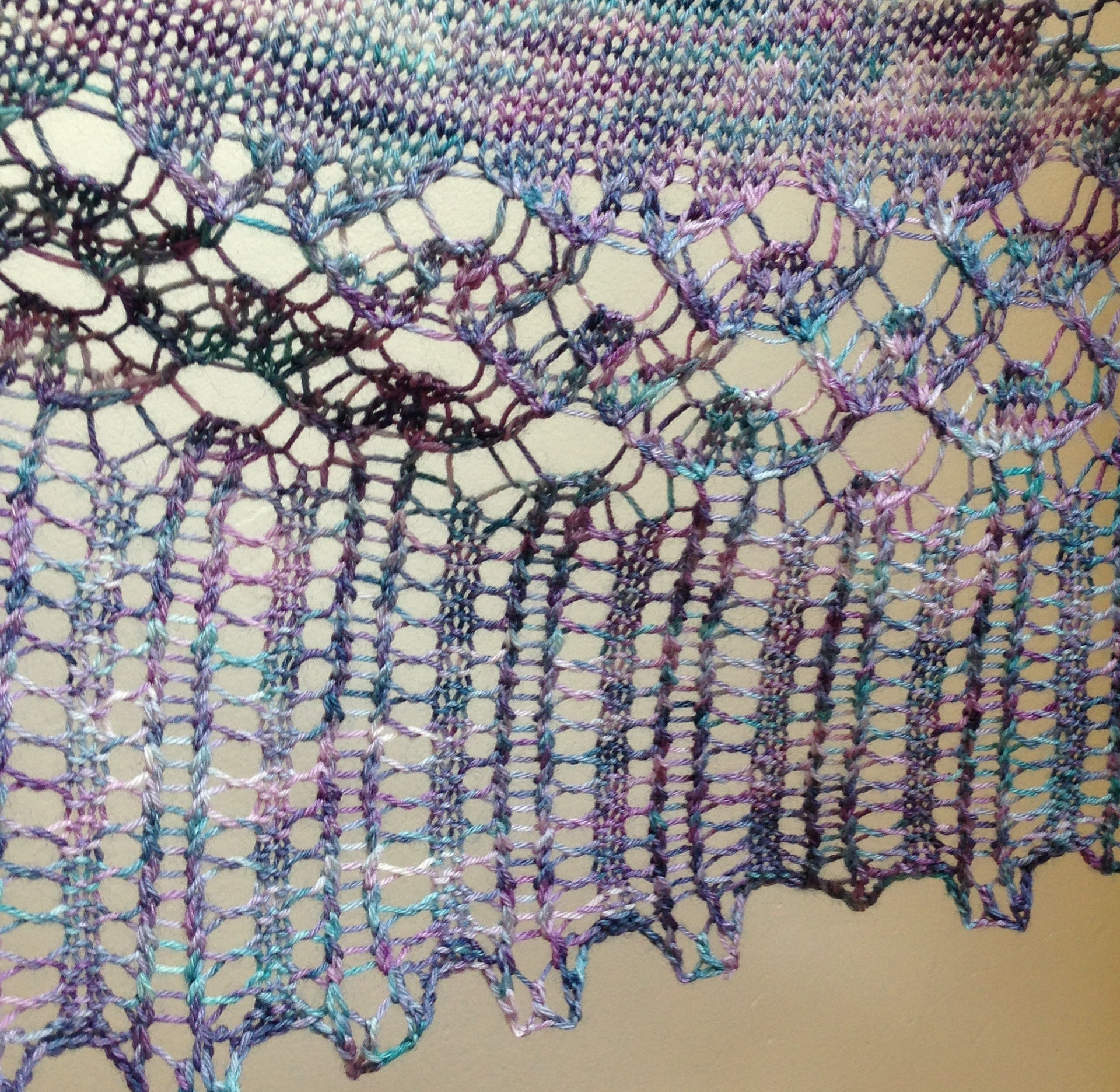 This is my first lace shawl and I’m going to release it just as soon as it’s tech-edited and tested. Could be as close as two weeks away or as much as a month, but either way looks like it’s going to be my next released pattern.
I’m stoked to say that the response to Kaava has been overwhelmingly good. The yarn is 100% blue-faced leicester, handdyed by a friend and member of The Harrow Knitters, Shamu Makes, who has a fab eye for colour. I made it originally to go with a purple dress, but actually, it looks gorgeous with turquoise. I blocked it really hard and it has graceful, flowing drape. The main stitch patterns in it are Stocking Stitch, Shower Stitch and Lacy Rib, and the crochet bind-off reminds me of castle crenels or cogs. Something very engineering-y, anyway :)
My next projects are lots and lots of proposals – sketching, swatching and specc’ing, but I do also has some more of my own patterns in the pipeline. I find it hard to prioritise my own patterns over everything else that needs to be done – any one out there want to be my drill sergeant?
I’m looking forward to the Summer holidays – I’ll be home in Dublin for a week in August, so I’d love to catch up with the Irish yarny world, aon sceal nua for me?
Hugs, and proud to get to post #100! (It’s the little accomplishments!)
x Elanor
Here’s a shawlette that’s a little bit of a challenge, but in manageable doses.
Moody, arty shot follows:

The Kaava shawlette is knit flat, top-down, starting with a garter st tab CO. Then there are three featured sts: st st, shower st (a double-sided lace) and Lacy Rib (which is a super simple one-sided lace). Then a crochet bind-off gives the shawl edge the appearance of a clockwork cog.
I’m looking for testers now, so drop by the Free Pattern Testers group if you’re interested! I’ll put a link here when the request is approved.
Competition time!
To celebrate my first published pattern, I’m having a giveaway!
Win yarn, needles and a copy of Knit Now 22!

All you have to do is comment below describing or linking to your favourite 3D or innovative stitch pattern. Leave me a way to get back in touch! (i.e. don’t be anonymous!)
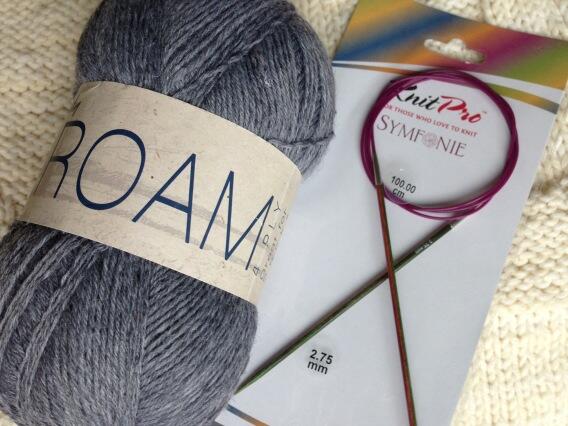
The prize is a ball of Wendy Roam 4 ply, Knitpro 100cm circular needles, size 2.75mm and a copy of Knit Now 22, which goes on sale on May 30th.
The competition is open to residents in the UK and Ireland. I reserve the right to add further competition caveats and rules as I go along.
Also, thought you should know, I made and frogged a small (tiny) tension swatch with the first few yards of the yarn. Soz!
The Zebra Chevron Slip-Stitch Colourwork pattern is one of my favourite stitch patterns, and it’s surprisingly easy to work. I think you’ll agree it makes for a striking pattern, and all it is is stripes of knit sts with a few slip stitches thrown in.
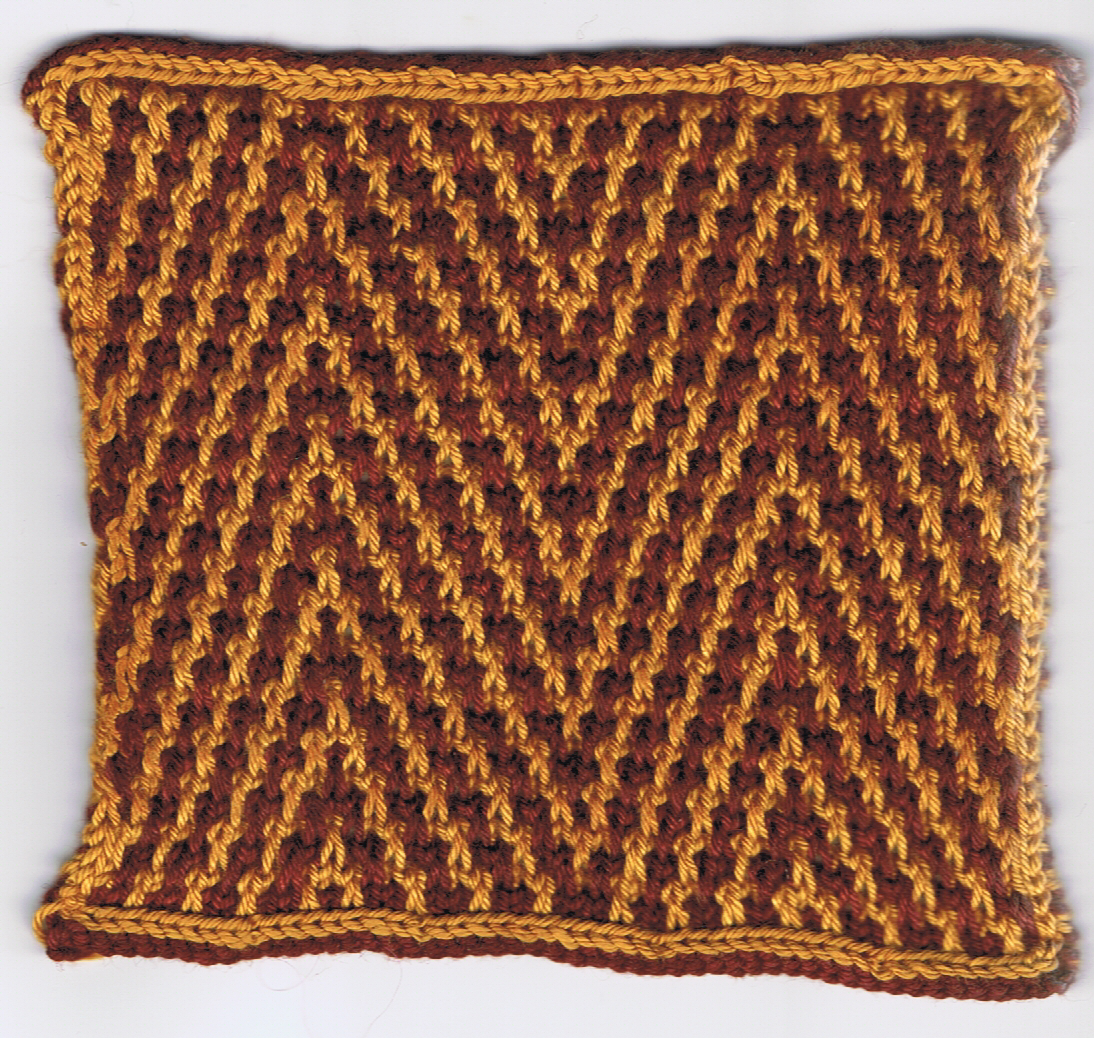
To work this st, you work in stripes of colours, knitting 1 to 3 sts in the colour you are using this stripe, and slipping sts that you want to leave in the contrasting colour. Always slip purlwise, so no twist is introduced into the st.
Rnds 1 & 2: With colour A, [k2, sl1] 8 times.
Rnds 3 & 4: With colour B, [sl1, k2] 3 times, sl1, k3, [sl1, k2] 3 times, sl1, k1.
Rnds 5 & 6: With A, k1, sl1, [k2, sl1] 3 times, k1, sl1, [k2, sl1] 3 times, k2.
Rnds 7 & 8: With B, repeat Rows 1 & 2.
Rnds 9 & 10: With A, repeat Rows 3 & 4.
Rnds 11 & 12: With B, repeat Rows 5 & 6.
To knit it flat, work the odd rows as written, and then for the even rows, just slip (wyif) the slip sts and purl the knit sts of the previous row.
Here’s the chart:


The fabric produced when working a mosaic or slip-stitch pattern is much denser than plain stocking st. This is because you’re effectively working every row twice; once with each colour. The fabric is firmer, with less stretch, but it’s warmer too.
I have used this stitch pattern in an up-coming garment at the waistband. The geometric lines plus a little extra shaping draw the eye in at the waist, so if you’ve got curves, this is a great way to show ’em off. Sneaky peek:

I work in inches because
So if I give measurements elsewhere in the blog without giving the units, please assume inches.
Unless I’m being derogatory about a male enemy. Then it’s cm mm.
I previously explained why I think the Sleeve Cap can be described by an oval. Basically, a sleeve can be thought of as a cone which intersects the “plane” of the sweater/cardigan.
 This produces an ellipse.
The perimeter of the ellipse is at least the same as the perimeter of the matching armscye on the body of the garment. If the perimeter of the ellipse is smaller than the armscye, it won’t “fit” – used in cap sleeves only. If the perimeter of the ellipse is larger than the armscye, you can ease the excess all around, or into the top to produce a gather. In any event, the armscye perimeter can be calculated from the garment body measurements.
You also will have a measurement for top arm circumference. The top arm circumference for a woman of average height is around
| Bust | 32 | 36 | 40 | 44 | 48 |
| Top Arm Circumf. | 10.5 | 11.5 | 13 | 14 | 15.5 |
Don’t forget to add ease! This is an unclothed measurement.
You can see from the diagram below, that the top arm circumference, i.e. the widest part of the sleeve, is equivalent to the width of two ellipses (0.5 + 1 + 0.5 ellipse widths). Hence, the horizontal radius of the sleeve cap ellipse is a quarter of the top arm circumference.

The sleeve cap height is twice the vertical radius of the ellipse, i.e. the same as the height of one ellipse.
If you plug the values for perimeter and horizontal radius into Ramanujan’s Approximation for the perimeter of an ellipse, you can get a good-enough value for the sleeve cap height.
The sleeve cap height is twice the value for c, the vertical radius of the ellipse, approximated by
Where p is the armscye perimeter / pi
And w is the top arm circumference / 4
The approximation above is essentially Ramanujan’s Approximation expressed in terms of one of the radii.
 Catchloops