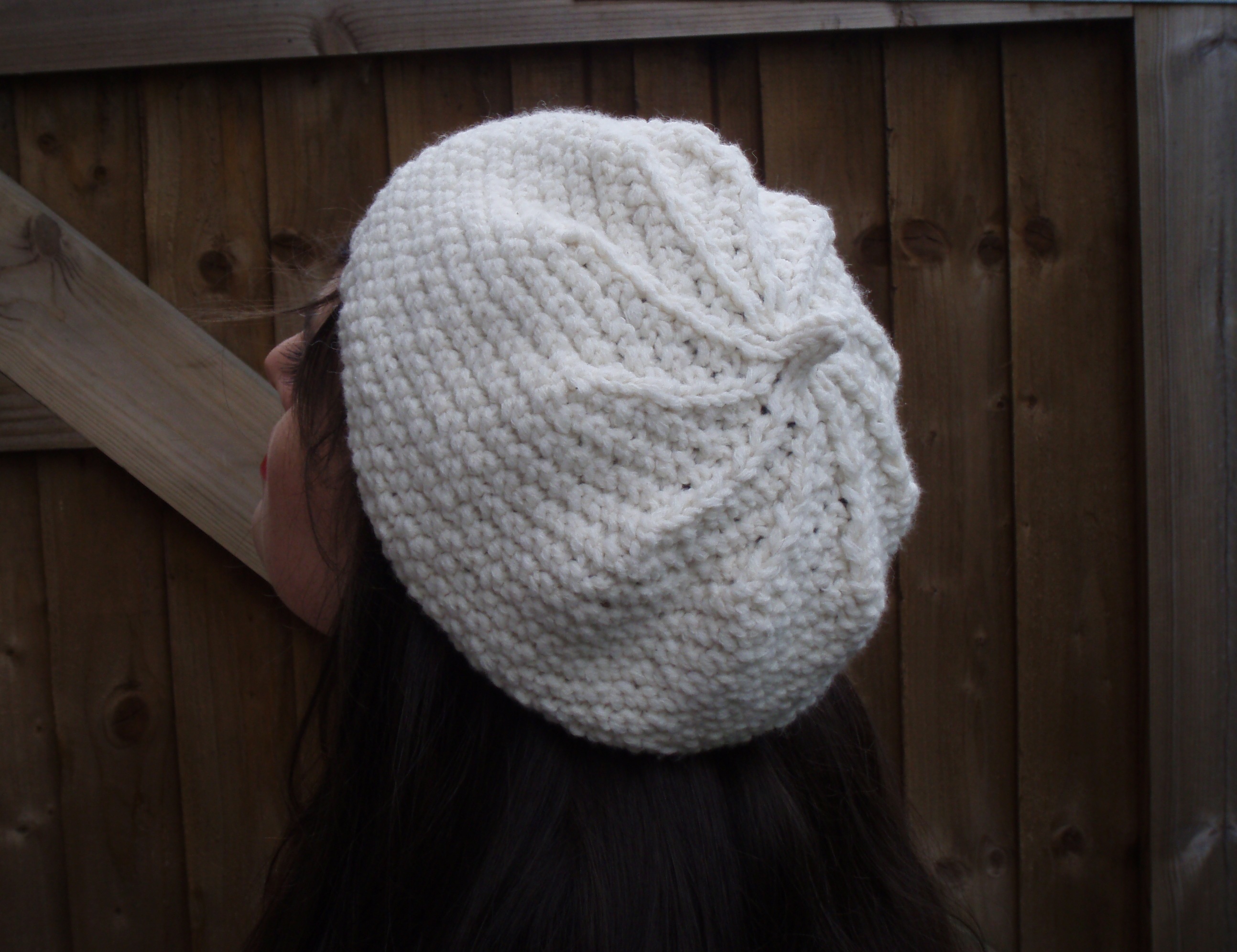
This is the hat that I designed in the WoollyWormhead hat design workshop, so I’m uncomfortable about accepting money for it. On the other hand, I put a lot of work into it, so I don’t want to give it away either. Greater exposure or not! So therefore I’m putting it up for sale, but I’m giving all proceeds to Tommy’s, who will make better use of it than I.
Tommy’s funds research into pregnancy problems and provides information to parents. We believe it is unacceptable that one in four women will lose a baby during pregnancy and birth.
I learned to knit when I was first expecting. Unfortunately, the pregnancy turned out to be what the docs call a “blighted ovum”, as my husband and I found out at the 12-week scan. Afterwards I was astounded by the number of women around me that had also had miscarriages. How come it’s not talked about? J and I felt like we were all alone in the world at the time. I finished knitting the little baby blanket I had started and my daughter has it on her bed now.
One Friday last month I got an E-mail to say a place had opened up on the Sunday’s Hat Design Course with WoollyWormhead at ThisIsKnit. Boy, I jumped on that sucker as soon as I could. And then I did a little happy dance.
Then my sister got engaged and cue two days of hard-core Family drinking. (How dare she? I blames the BIL2B!)
So Sunday didn’t open pretty. Managed to get myself into town and round the back/front of Powerscourt townhouse. Squee’d over some lush goodies in the shop, especially some Coolree, which is new to the shop since I was there last in May, and then went upstairs to meet Woolly and make lust on her enormous piles of beautiful hats. Which we got to try on and see which suited the old noggins better. I’m sure I can wear anything, darlings, but none of them went very well with my bloodshot eyes.
We finally set down to the business of choosing what to make. I decided to go beret and made up a complicated stitch pattern. I needed to CO 60 sts. At which point I realised I had the shakes.
Six attempts later, I had JUST about got the thing going. Complicated stitch pattern had gone the way of the faeries and thankfully it was time for lunch. We all got chatting at a local eaterie (Calzone cafe) and Woolly was just so amazingly interesting. We heard a bit about her life as a designer, her little boy and the story of his first hat, and life in a double decker bus in a caravan site/artists commune in Italy.
Good food, company and some fresh squeezed OJ had me nearly human again, and when we got back, I could participate properly. Woolly helped me with figuring out the decrease rate for the crown and she gave us guidelines for grading. Her notes a great – concise but with a lot of information – plenty of stuff she’s gleaned over the years from designing. You can just up and run with it and design your own hats quite fearlessly, thanks to the way she’s put it all together.
So I did get a hat by the next day (only one of us got it done in the class). And best of all we got to see lots of Woolly’s upcoming or barely released designs.
And I’m getting me some Coolree next time I’m in Dub.
Still working on armholes and armscyes and caps and ellipse perimeters. Was very happy to discover Ramanujan’s approximation for the perimeter of an ellipse:
And this great page from My Measuring Tape on drafting different styles of sleeves is easily adaptable to knitted wares.
I have been slowly working my way down through Knitty’s Knitted Sleeve editorial from ’05, and I’m now around about the point where I realise I really have to get the armscye sorted before going ahead with designing the sleeve cap :)
I have the bodice armscye mostly sorted now, but I’ve been looking for some kind of indication as to what slope to use for the curve of the cast off (working up) at the armhole. If it’s too slow to decrease, the armscye will be triangular, and if it’s too quick, it’ll be square. What’s the happy, curvy, medium? I found a physical armscye curve online, having read this article on pattern drafting on Your Wardrobe Unlocked.
So, if the physical object exists, there must be a software equivalent, right? (my design’s totally digital) Or even just an equation… but can I find one? Nay, I say unto thee, my google searching skillz extends not to such a hit.
Still workin’ on it.
Boy is design hard.
But I absolutely looooove it!!!!!
Ooh, update! I’ve discovered from this UTube video by munnikusum, that a good place for the curve to end (just before the vertical rise to the shoulder) is halfway up that shoulder line.
Last night I popped up a formula for calculating the stitches on a particular row in the cap of a set-in sleeve. And I kind of just left it there, with no explanation. My excuse is my eyelids were sticking to my eyeballs from lack of sleep.
So, now let’s not talk about knitting or maths at all and go on to glass production.
Way back when, if you wanted a pane of glass, you got a glass blower to spin a disc of molten glass. The disc would be cut to shape when it cooled and every pane would have a pontil mark from the glassblower’s pipe. (circa mid 1700’s)
In 1953, the Pilkington brothers developed the float-glass method for making flat glass.
In between, if you wanted flat glass without a pontil mark, your blower would blow up a cylinder, knock off the ends and cut the still malleable glass up one of the sides. He then opened and flattened the cylinder into a rectangle. It never went completely flat, which is why some old glass looks “wavy”.
Glass cylinder to flat rectangle
Sleeves at their most basic are cylinders. If you knit one flat, you make a rectangle just like the glass cylinders above. Now, scale it up just a teensy bit, and a sleeve can probably be better approximated by a truncated cone intersecting a plane. Unless you’re making a cap sleeve, the armhole is also a closed curve. Hence, it’s an ellipse. Just needs a bit of chopping up to get it flat.
A set-in sleeve on a pattern schematic looks like the below. (Actually, usually they’re a bit wider, proportionally speaking).
Set-in sleeve cap
Now, the equation I came up with last night is pretty much the same as the one I gave for knitting a circle. If you use it in the same way, you will knit an ellipse. Here’s that ellipse one again:
This reads “the number of stitches on row n is a (measured in stitches) by the root of (1 minus (the row number by the gauge over b (measured in stitches)) squared)”
a is half the width of the ellipse and b is half the height.
gauge is sts/10cm over rows/10cm
This will give you the stitches for a quarter of the ellipse (i.e. the curve in the positive x & y quadrant on the cartesian plane), you need to double it to get the stitch count for an entire row and mirror it to get the corresponding bottom half of the ellipse (where y<0).
However!
We want to do set-in sleeves. We’re not actually knitting an ellipse, we’re knitting the cylinder from which an ellipse has been cut, i.e. the negative space of the ellipse.
So the sleeve circumference at its widest point (usually, unless you’re doing a bishop or bell, more on that to come!!!) is usually at the bicep (check out this knitty winter ’04 feature). Call this circumference cAssuming a sleeve which is the same width as the armhole at the intersection (i.e. straight, not a puffy sleeve with extra material), then a is c/4. b is half the depth of the armhole. Very important note: these are the measurements of the fabric, not the model.
Assuming bottom-up construction, the sleeve width just as you are about to start decreasing for the sleeve cap is c. Set n = 1 and increase by 1 for each row. The rowcount decreases at a rate of to the midpoint of the set-in curve, when . Then, the rowcount continues to decrease, and the simplest way to calculate it thereafter is to just reset n=1 and use
So that’s my convoluted THEORY. Need to knit it up and see if it works! I’ll update again when I do.
This, I believe, is a formula for calculating the number of stitches on a row for the sleeve cap of a set-in sleeve, given a = half the width of the armhole, b = half the height of the armhole.
I shall write more tomorrow, I haven’t sufficiently explained how to use this to get a complete set of rowcounts for the sleeve cap. When it’s done though, I’d be interested to see if knitters out there concur.
Hmmm, wonder if I could do this for money? I solemnly vow to apply these rules rigorously to everything I design henceforth.
I have copied this checklist from Stephannie Tallent’s technical editing page. She offers tech editing as a service as well as some fab patterns (ooh, wrought socks, lust!).
What is technical editing for knitting?
Checking all math.
Checking all sizing/grading.
Ensuring all stitch counts are correct.
Ensuring stitch multiples are set up accurately.
Checking that the dimensions are accurate based on gauge and instructions.
Checking the pattern numbers against the schematic measurements.
Checking the schematic for accuracy.
Checking chart(s) for accuracy.
Checking the pattern against the chart(s).
Ensuring all conversions are correct (ex. inches to centimetres).
Measurements are rounded appropriately and consistently.
Checking yarn requirements for different sizes.
Ensuring any tutorials and/or special instructions are logical and easy to follow.
Other things I check:
Formatting of headings/subheadings/body copy is consistent and logical.
Body copy is easily understandable and grammatically correct.
Style, language and phrases are consistent.
Rows are noted as rows and rounds as rounds.
Punctuation is correct; rows/rounds end with a period.
All supplies are listed.
Gauge is always done in x sts by y rows = 4 in.
Gauge is available for both Stockinette stitch and any pattern stitches.
Use of fractions or decimals is consistent.
Use of abbreviations & capitalization is consistent.


 Catchloops