What a lot of love went into this quilt.
Increases and Decreases
Sizing references
Doomed
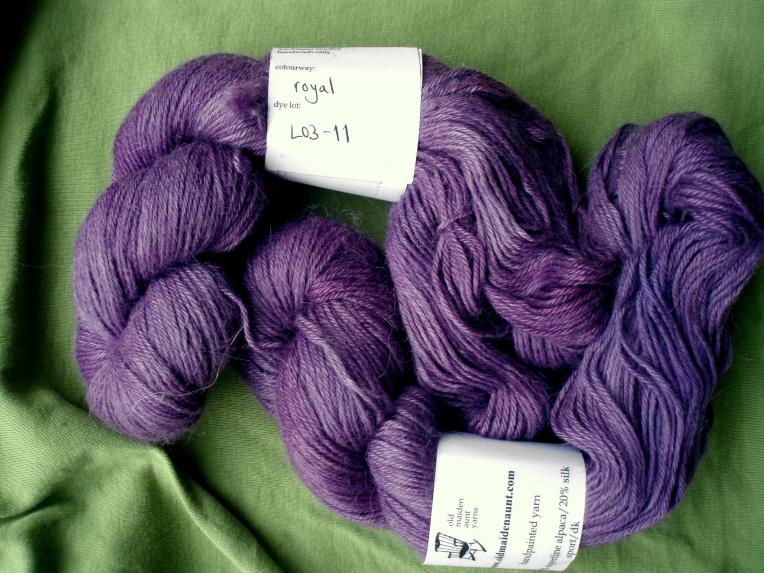
Well, that was never going to work, was it? Me? Got to a joyful LYS and come away empty-handed?
What a difference a diameter makes
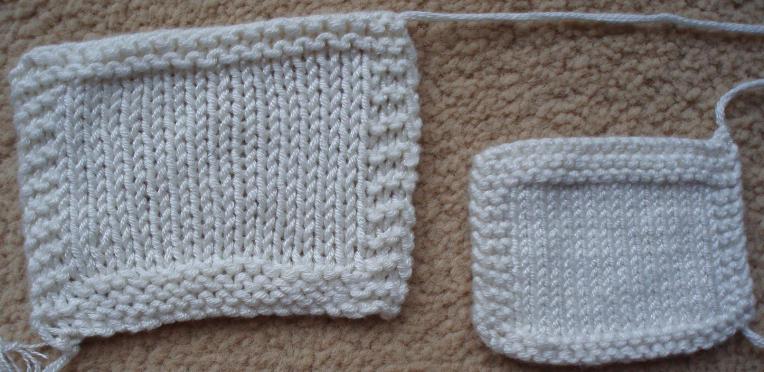
On the left, we have 6g of sirdar flirt knit on 4.5mm needles
On the right, we have 4g knit on 2.75 needles
21 sts cast on, 25 rows.
Loop-di-loop!
Excited to have an excuse to go fondle some yarn! I need to source some DK-weight silk (or bamboo) blend yarn in high-contrast colours from an indie yarnie or spinner based in the UK or Ireland. This is for a design that needs to be finished by July 1st, so LET ME KNOW if you have such a beast!
I’m going to take the two little skeinlings with me, oh joy! Does the buggy come too or no? Eternal question for mums on the tube! Tired babies versus hoiking the wheels… no, it comes, otherwise i’ll be carrying the pair of lumps up all those stairs at Angel!
I’m especially eager to see these yarns:

 Old Maiden Aunt – Alpaca Silk Sport/fine DK
I really, really hope loop have swatched with these, cos otherwise I may be spending <gulp> £38 squids!
Monaco Grand Three

Nice colours for ducks?
Knitting Ovals, Ellipses and Cylinders
Last night I popped up a formula for calculating the stitches on a particular row in the cap of a set-in sleeve. And I kind of just left it there, with no explanation. My excuse is my eyelids were sticking to my eyeballs from lack of sleep.
So, now let’s not talk about knitting or maths at all and go on to glass production.
Way back when, if you wanted a pane of glass, you got a glass blower to spin a disc of molten glass. The disc would be cut to shape when it cooled and every pane would have a pontil mark from the glassblower’s pipe. (circa mid 1700’s)
In 1953, the Pilkington brothers developed the float-glass method for making flat glass.
In between, if you wanted flat glass without a pontil mark, your blower would blow up a cylinder, knock off the ends and cut the still malleable glass up one of the sides. He then opened and flattened the cylinder into a rectangle. It never went completely flat, which is why some old glass looks “wavy”.

Sleeves at their most basic are cylinders. If you knit one flat, you make a rectangle just like the glass cylinders above. Now, scale it up just a teensy bit, and a sleeve can probably be better approximated by a truncated cone intersecting a plane. Unless you’re making a cap sleeve, the armhole is also a closed curve. Hence, it’s an ellipse. Just needs a bit of chopping up to get it flat.
A set-in sleeve on a pattern schematic looks like the below. (Actually, usually they’re a bit wider, proportionally speaking).

Now, the equation I came up with last night is pretty much the same as the one I gave for knitting a circle. If you use it in the same way, you will knit an ellipse. Here’s that ellipse one again:
This reads “the number of stitches on row n is a (measured in stitches) by the root of (1 minus (the row number by the gauge over b (measured in stitches)) squared)”
a is half the width of the ellipse and b is half the height.
gauge is sts/10cm over rows/10cm
This will give you the stitches for a quarter of the ellipse (i.e. the curve in the positive x & y quadrant on the cartesian plane), you need to double it to get the stitch count for an entire row and mirror it to get the corresponding bottom half of the ellipse (where y<0).
However!
We want to do set-in sleeves. We’re not actually knitting an ellipse, we’re knitting the cylinder from which an ellipse has been cut, i.e. the negative space of the ellipse.
So the sleeve circumference at its widest point (usually, unless you’re doing a bishop or bell, more on that to come!!!) is usually at the bicep (check out this knitty winter ’04 feature). Call this circumference c Assuming a sleeve which is the same width as the armhole at the intersection (i.e. straight, not a puffy sleeve with extra material), then a is c/4. b is half the depth of the armhole. Very important note: these are the measurements of the fabric, not the model.
Assuming bottom-up construction, the sleeve width just as you are about to start decreasing for the sleeve cap is c. Set n = 1 and increase by 1 for each row. The rowcount decreases at a rate of to the midpoint of the set-in curve, when
. Then, the rowcount continues to decrease, and the simplest way to calculate it thereafter is to just reset n=1 and use
So that’s my convoluted THEORY. Need to knit it up and see if it works! I’ll update again when I do.
Set-in Sleeves Cap Formula
Here’s something I’ve been playing with.
This, I believe, is a formula for calculating the number of stitches on a row for the sleeve cap of a set-in sleeve, given a = half the width of the armhole, b = half the height of the armhole.
I shall write more tomorrow, I haven’t sufficiently explained how to use this to get a complete set of rowcounts for the sleeve cap. When it’s done though, I’d be interested to see if knitters out there concur.
Night!
xxx
 Catchloops