To celebrate my first published pattern, I’m having a giveaway!
Win yarn, needles and a copy of Knit Now 22!
Josephine Anderson for BOSS models is wearing my latest pattern “In the Loop”. This cowl features a funky 3D stitch pattern that creates leaning holes and loops, all without breaking the yarn. It’s knit with Wendy Roam Fusion and the pattern is available in Knit Now 22 – which goes on sale May 30th. Photos by Dan Walmsley and reproduced here with kind permission from Practical Publishing.
All you have to do is comment below describing or linking to your favourite 3D or innovative stitch pattern. Leave me a way to get back in touch! (i.e. don’t be anonymous!)
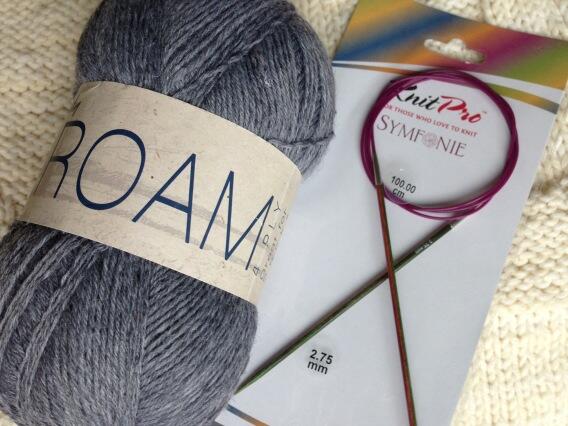
Win yarn and needles to make my “In the Loop” cowl from Knit Now 22.
The prize is a ball of Wendy Roam 4 ply, Knitpro 100cm circular needles, size 2.75mm and a copy of Knit Now 22, which goes on sale on May 30th.
The competition is open to residents in the UK and Ireland. I reserve the right to add further competition caveats and rules as I go along.
Also, thought you should know, I made and frogged a small (tiny) tension swatch with the first few yards of the yarn. Soz!
Wahey! All you peeps out there who want to learn to knit, good news!
I’ll be teaching in Hobbycraft Watford starting Tuesday 16th at 11am – 12pm.
Currently the plan is to have four lessons as follows:
Lesson 1 (April 16th): Casting on and getting started: Free!
Lesson 2 (April 23rd): Different stitches and casting off: £5
Lesson 3 (April 30th): Yarn, gauge and tension: £5
Lesson 4 (May 7th): Shaping with increases and decreases: £5
Each of the lessons will be drop-in – so you can pick and choose which ones to come to. However, I recommend booking a place in advance to ensure your place, as there’s only room for 6. Please bring 4mm needles and DK-weight yarn. I will be in the store from 10.30am for help and questions.
e-mail me on catchloops@gmail.com or call on 0774 280 3656 for more information.
Hobbycraft Watford’s address: Century Park, Walton Way, WD17 2SF
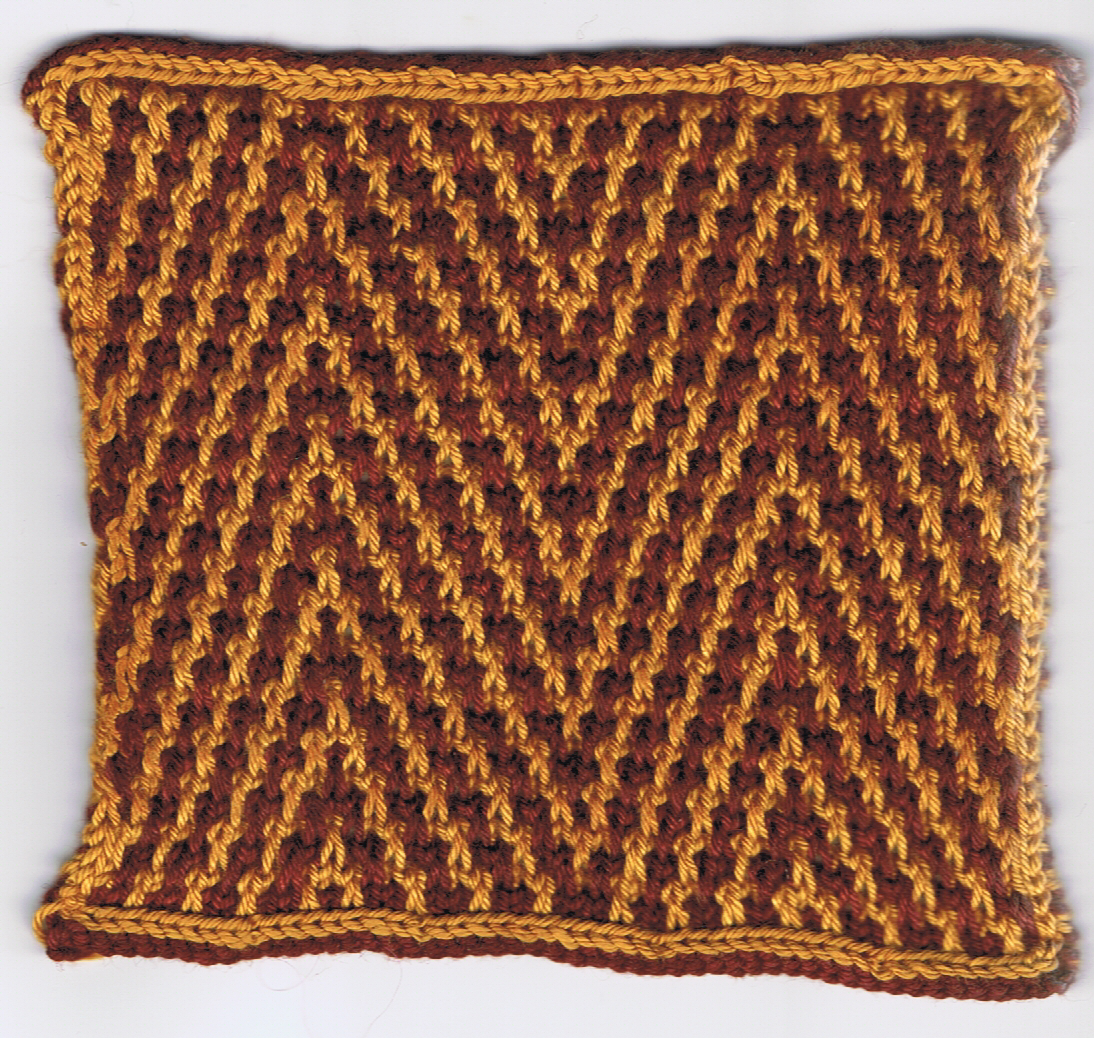
The Zebra Chevron Slip-Stitch Colourwork pattern is one of my favourite stitch patterns, and it’s surprisingly easy to work. I think you’ll agree it makes for a striking pattern, and all it is is stripes of knit sts with a few slip stitches thrown in.
Zebra Chevron Swatch
To work this st, you work in stripes of colours, knitting 1 to 3 sts in the colour you are using this stripe, and slipping sts that you want to leave in the contrasting colour. Always slip purlwise, so no twist is introduced into the st.
Rnds 1 & 2: With colour A, [k2, sl1] 8 times. Rnds 3 & 4: With colour B, [sl1, k2] 3 times, sl1, k3, [sl1, k2] 3 times, sl1, k1. Rnds 5 & 6: With A, k1, sl1, [k2, sl1] 3 times, k1, sl1, [k2, sl1] 3 times, k2. Rnds 7 & 8: With B, repeat Rows 1 & 2. Rnds 9 & 10: With A, repeat Rows 3 & 4. Rnds 11 & 12: With B, repeat Rows 5 & 6.
To knit it flat, work the odd rows as written, and then for the even rows, just slip (wyif) the slip sts and purl the knit sts of the previous row.
Here’s the chart:
The fabric produced when working a mosaic or slip-stitch pattern is much denser than plain stocking st. This is because you’re effectively working every row twice; once with each colour. The fabric is firmer, with less stretch, but it’s warmer too.
I have used this stitch pattern in an up-coming garment at the waistband. The geometric lines plus a little extra shaping draw the eye in at the waist, so if you’ve got curves, this is a great way to show ’em off. Sneaky peek:
Today, I have been learning many things about publishing and marketing, and editing in particular.
What’s brought all this on? Well, a very patient friend of mine, Oliver Rhodes, founded online publishing house Bookouture six months ago. He’s already signed some great authors and the marketing work he did on Blood Shadows by Lyndsay J. Pryor was comprehensive and penetrating. I happened to unleash the inner-demon grammar-pedant in Olly’s hearing once and he offered to show me a little bit of behind-the-scenes editing work – I couldn’t refuse such an interesting exercise.
Wicked Marketing: Bookouture’s Trailer for Blood Shadows by Lindsay J. Pryor
I tried my hand at it – editing’s tougher than it looks – it’s not like maths, where the answer is either right or it’s not, and there are checks you can make. Editing is as much about style as about correct grammar. You look for continuity errors, disambiguate and tweak awkward sentences, However, you also have to rein in the desire to make so many changes you lose the author’s voice – leave good enough alone.
I’ve learned about dangling participles, misplaced modifiers, and other grammatical errors. I think I’ve got a handle on the difference between structural editing (pulling the story into the best possible shape) and line editing (“a careful reader points out inconsistencies and annoying stylistic tics”). I now know the difference between a proofreader and a copy-editor: the former checks for errors in the typeset version of a text including errors the copy-editor may have missed; the latter checks for grammatical errors, syntax, meaning, spelling, awkwardness etc. in the text. I think I would make quite a good copy-editor. By Murphy’s Law, there’ll be a whole lotta errors in this blog that prove otherwise, of course.
The professional body of editors and proofreaders in the UK have their website at http://www.sfep.org.uk/. This crew runs courses and provides accreditation in editing. I am quite interested in taking some of the courses. I might start out by getting a copy of Butcher’s Copy-editing, however, before I go haring off after another new career that doesn’t pay much. You don’t happen to have a copy of it lying around, do you? I could pay you in yarn!!?
Bookouture’s next release is “Blood Roses” by Lyndsay J. Pryor – Due out April 26th.




 Catchloops