Beginning Knitting Lessons

Beginning Knitting Classes
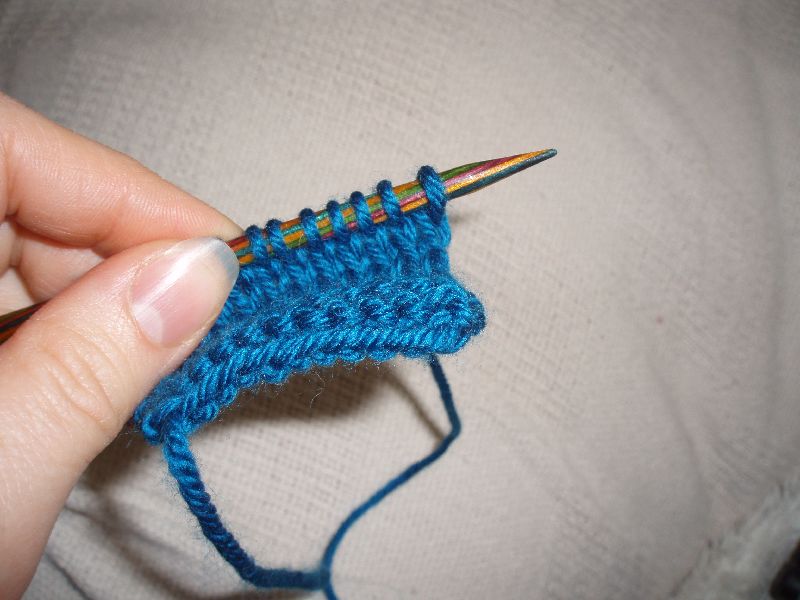
 

Start on the RS

Wahey! All you peeps out there who want to learn to knit, good news!

I’ll be teaching in Hobbycraft Watford starting Tuesday 16th at 11am – 12pm.

Currently the plan is to have four lessons as follows:

Lesson 1 (April 16th): Casting on and getting started: Free!
Lesson 2 (April 23rd): Different stitches and casting off: £5
Lesson 3 (April 30th): Yarn, gauge and tension: £5
Lesson 4 (May 7th): Shaping with increases and decreases: £5

Each of the lessons will be drop-in – so you can pick and choose which ones to come to. However, I recommend booking a place in advance to ensure your place, as there’s only room for 6. Please bring 4mm needles and DK-weight yarn. I will be in the store from 10.30am for help and questions.

e-mail me on catchloops@gmail.com or call on 0774 280 3656 for more information.

Hobbycraft Watford’s address: Century Park, Walton Way, WD17 2SF
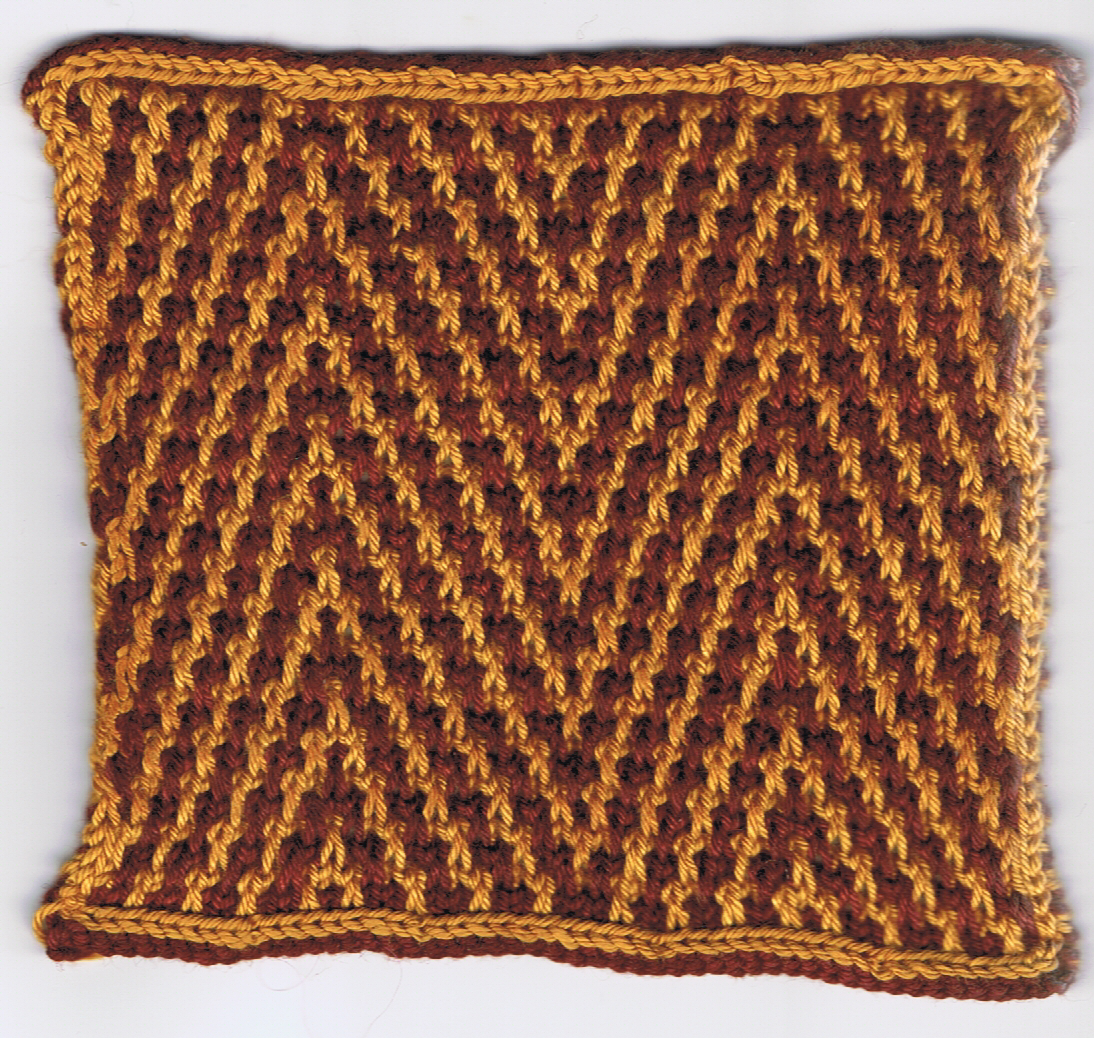
Zebra Chevrons in Slip-Stitch (or Mosaic) Colourwork

The Zebra Chevron Slip-Stitch Colourwork pattern is one of my favourite stitch patterns, and it’s surprisingly easy to work. I think you’ll agree it makes for a striking pattern, and all it is is stripes of knit sts with a few slip stitches thrown in.

Zebra Chevron Swatch

To work this st, you work in stripes of colours, knitting 1 to 3 sts in the colour you are using this stripe, and slipping sts that you want to leave in the contrasting colour. Always slip purlwise, so no twist is introduced into the st.

Rnds 1 & 2: With colour A, [k2, sl1] 8 times.
Rnds 3 & 4: With colour B, [sl1, k2] 3 times, sl1, k3, [sl1, k2] 3 times, sl1, k1.
Rnds 5 & 6: With A, k1, sl1, [k2, sl1] 3 times, k1, sl1, [k2, sl1] 3 times, k2.
Rnds 7 & 8: With B, repeat Rows 1 & 2.
Rnds 9 & 10: With A, repeat Rows 3 & 4.
Rnds 11 & 12: With B, repeat Rows 5 & 6.

To knit it flat, work the odd rows as written, and then for the even rows, just slip (wyif) the slip sts and purl the knit sts of the previous row.

Here’s the chart:

Zebra Chevron Chart

zebrakey

The fabric produced when working a mosaic or slip-stitch pattern is much denser than plain stocking st. This is because you’re effectively working every row twice; once with each colour. The fabric is firmer, with less stretch, but it’s warmer too.

I have used this stitch pattern in an up-coming garment at the waistband. The geometric lines plus a little extra shaping draw the eye in at the waist, so if you’ve got curves, this is a great way to show ’em off. Sneaky peek:

Zebra Chevron Slip Stitch Colourwork

Proofreading and Copy-editing

Today, I have been learning many things about publishing and marketing, and editing in particular.

What’s brought all this on? Well, a very patient friend of mine, Oliver Rhodes, founded online publishing house Bookouture six months ago. He’s already signed some great authors and the marketing work he did on Blood Shadows by Lyndsay J. Pryor was comprehensive and penetrating. I happened to unleash the inner-demon grammar-pedant in Olly’s hearing once and he offered to show me a little bit of behind-the-scenes editing work – I couldn’t refuse such an interesting exercise.


Wicked Marketing: Bookouture’s Trailer for Blood Shadows by Lindsay J. Pryor

I tried my hand at it – editing’s tougher than it looks – it’s not like maths, where the answer is either right or it’s not, and there are checks you can make. Editing is as much about style as about correct grammar. You look for continuity errors, disambiguate and tweak awkward sentences, However, you also have to rein in the desire to make so many changes you lose the author’s voice – leave good enough alone.

I’ve learned about dangling participlesmisplaced modifiers, and other grammatical errors. I think I’ve got a handle on the difference between structural editing (pulling the story into the best possible shape) and line editing (“a careful reader points out inconsistencies and annoying stylistic tics”). I now know the difference between a proofreader and a copy-editor: the former checks for errors in  the typeset version of a text including errors the copy-editor may have missed; the latter checks for grammatical errors, syntax, meaning, spelling, awkwardness etc. in the text. I think I would make quite a good copy-editor. By Murphy’s Law, there’ll be a whole lotta errors in this blog that prove otherwise, of course.

The professional body of editors and proofreaders in the UK have their website at http://www.sfep.org.uk/. This crew runs courses and provides accreditation in editing. I am quite interested in taking some of the courses. I might start out by getting a copy of Butcher’s Copy-editing, however, before I go haring off after another new career that doesn’t pay much. You don’t happen to have a copy of it lying around, do you? I could pay you in yarn!!?

Bookouture’s next release is “Blood Roses” by Lyndsay J. Pryor – Due out April 26th.

Blood Roses by Lindsay J. Pryor

About

I’ve updated my About page. It now looks like this.

Yours Truly

 Catchloops Headshot

Way back when, I trained to be an engineer. I helped out as a bouncer at Star Trek conventions (keeping the Klingons and Romulans apart was FUN), I read every Neal Stephenson and Lois McMaster Bujold book I could lay my hands on, I geeked out on the S/MIME protocol, I wrote online casino games and at one point I was team lead on The Lancet website. Then I got a life. Literally.

I taught myself to knit about 6 years ago when I found out I was pregnant. I had this vague, fuzzy picture of myself in a rocking chair, needles clacking away as the angelic child slept in a gauze-draped cot. Yeah, right. So I didn’t really knit again until baby #2 was on the way (when my head went all fuzzy again). That time it stuck, though. Probably because I joined an active and supportive knitting group, The Harrow Knitters. They’re the ones who introduced me to Ravelry. I just kept going, eager to discover new techniques and cool new configurations. Eventually I got to the stage where I knew precisely what I next wanted to knit, but couldn’t find a suitable pattern anywhere. So I just made it. And then, slowly, started writing the instructions down, and turning them into patterns.

Last March, I decided to really go for it and started submitting formal proposals to publishers. My very first one was picked, I was chuffed! Cue many months of frantically trying to MAKE what my head had envisioned. My brain was finally being used for something engrossing, not just entertaining toddlers.

Since then, I haven’t looked back. I have more patterns lined up for publishing in various magazines, and I’ll be releasing more myself too. I’ll put all the news right here on this blog.

Nowadays my favourite thing to do is sit in a Café with my gorgeous babies and people-watch together. We go on a Saturday after ballet while Daddy has a lie-in. They have babyccinos and I have a hot chocolate. There’s usually a biscuit too. We go home and bounce on the bed to wake Daddy and then we all have a “family hug”.

Elanor King: Innovative and Classy Designs.

Find me everywhere as “catchloops”

BTW, I work in inches first, then translate into cm for the pattern

I work in inches because

  1. The clothing sizes that I am used to are in inches
  2. UK and US peeps both can understand inches (Desolée, Es tut mir leid!)
  3. I’m old-fashioned and hopelessly lazy
  4. The units of measurement are incidental anyway – one day, I think I’ll publish a pattern in light years, just for the laugh. Maybe my next Dr. Who one (last one).

So if I give measurements elsewhere in the blog without giving the units, please assume inches.

Unless I’m being derogatory about a male enemy. Then it’s cm mm.

Calculate Sleeve Cap Height Given Top Arm Circumference and Armscye Perimeter

I previously explained why I think the Sleeve Cap can be described by an oval. Basically, a sleeve can be thought of as a cone which intersects the “plane” of the sweater/cardigan.

This produces an ellipse.

The perimeter of the ellipse is at least the same as the perimeter of the matching armscye on the body of the garment. If the perimeter of the ellipse is smaller than the armscye, it won’t “fit” – used in cap sleeves only. If the perimeter of the ellipse is larger than the armscye, you can ease the excess all around, or into the top to produce a gather. In any event, the armscye perimeter can be calculated from the garment body measurements.

You also will have a measurement for top arm circumference. The top arm circumference for a woman of average height is around

Bust 32 36 40 44 48
Top Arm Circumf. 10.5 11.5 13 14 15.5

Don’t forget to add ease! This is an unclothed measurement.

You can see from the diagram below, that the top arm circumference, i.e. the widest part of the sleeve, is equivalent to the width of two ellipses (0.5 + 1 + 0.5 ellipse widths). Hence, the horizontal radius of the sleeve cap ellipse is a quarter of the top arm circumference.

The sleeve cap height is twice the vertical radius of the ellipse, i.e. the same as the height of one ellipse.

If you plug the values for perimeter and horizontal radius into Ramanujan’s Approximation for the perimeter of an ellipse, you can get a good-enough value for the sleeve cap height.

The sleeve cap height is twice the value for c, the vertical radius of the ellipse, approximated by

Where p is the armscye perimeter / pi

And w is the top arm circumference / 4

The approximation above is essentially Ramanujan’s Approximation expressed in terms of one of the radii.

Hot Water Bottle Croquis

Here, for your downloading pleasure, is a croquis for a hot water bottle. (Drumroll, please, for this important contribution to the world of fashion!)

Hot Water Bottle Croquis
Hot Water Bottle Outline Drawing

Does this picture look funky to you? Sometimes it displays for me like something in a heliotrope. Let me see if I can fix that….