Irish ones:
Indie Dyers & Spinners « Irish Knitting & Crochet.
UK ones:
indiedyer – seem to have stopped
Ooh, update, have just been sent this fabulous british yarn guide link
Irish ones:
Indie Dyers & Spinners « Irish Knitting & Crochet.
UK ones:
indiedyer – seem to have stopped
Ooh, update, have just been sent this fabulous british yarn guide link
Wow, that rocks.
Talking of Knitting with Rocks in it, the next one is May 14th in JL Oxford St.
I need some decent crochet hooks. A set, preferably, as I only have a few left – they seem to just disappear, for some reason. Ooh, I’ve been meaning to tell you about our Borrower. There’s one that lives somewhere near our couch where I like to sit in the evening. We’ve lost whole toys near it (and I ain’t talking McDonald’s Happy Meal size stuff here, either). Anyway, it likes buttons and unopened balls of yarn. Knitting needles, not so much, but it must EAT crochet hooks.
So, I’m having a look around to see what’s available in my price range. I have KnitPro Symfonie needles, and I do like to have everything matching, so maybe some of these from cafeknit?
I think with hooks, I really need to go down below a 3mm though, so I better go metal.
I also want rounded ends as I once gave myself a blister on the palm of my hand with a real cheapie.
On the other hand, I really only use them for edgings, so I don’t need to go overboard on luxury – rules out the lantern moons!
the-ultimate-crochet-hook-review reckons I need an in-line, pointy hook with a rest.
I’m gonna go hunting offline methinks. In the meantime, I might make do with one clover soft touch to try it out… in a 3mm or smaller, I think, since I’m working with 4ply a lot at the mo.
Open to suggestions though! Leave a comment!
Oh boy, I’d LOVE to go on a knitting holiday. This one looks amAAAzing: plug and play in pembrokeshire. Alas, pockets to let. Le sigh.
I’ve sorted myself out with a twitter account:Follow @catchloops
Apologies in advance for banalities and irrelevant retweets!
This is completely off-topic. No knitting here.
My four-year old is one of those inquisitive types. She likes to cross-examine me about any topic that springs to mind. The other night she decided it was “the olden times” so I had to turn out the lights and we got ready for bed by candlelight. And then she asked me “what did people do for cars?”, “what about television?”, clothes, toys, heat, cooking… the works. May the history Gods forgive me, my answers were a jumbled mess of Prehistoric to Regency to WW2. All while sitting in the dark looking at a single candle flame (the wax was apple scented, in case you needed to know).
Another thing she loves to do is “science experiments”. I occasionally have a brain wave for a new one to try, but I’m scraping the bottom of the barrel. Please, if you have good ones, let me know!
You need a measuring jug, glasses of different widths and heights and food dye (cos everyone loves food dye. Have fun getting it off their tiny little fingers!)
Measure the exact same amount of liquid into two different glasses – a fat one and a skinny one. While measuring, get the kid to shout out if you have too little or too much water for a certain measurement. Don’t forget the food dye. Then ooh and ah over the different heights of the liquid in the fat and skinny glasses.
Pour into different glasses and see what happens.
Then try to make the glasses “sing” by rubbing the rims.
Then clean up the mess.
Safety yadda yadda, glass, young kids, supervision required.
You need oil, water, squash or coke or another liquid that mixes with water and is preferably coloured, a fat straw (or funnel, pipette etc), 2 food dyes and washing-up liquid.
Mix the water and the squash: what happens?
Mix the water and the oil
Try 2 drops food dye in water/oil once it’s settled again (This one’s quite cool, I didn’t realise it would go that way).
Now insert a straw through the oil layer and drop the other food dye directly into the water.
Now ruin it all by adding the washing-up liquid.
:) Minutes of fun, simply minutes!
This is more of a lecture, cos they can’t go around messing with steam.
Get some ice, some water and a kettle.
Let them play with the ice, dunk it into water, see what happens.
Boil some water and show them (from a distance) the steam.
Solid, Liquid, Gas. Voila!
Take 4 kitchen ingredients that look the same and get the kids to try to identify what they are. We just happen to have coloured ramekins that are perfect for this. Get them to shut their eyes and count. In the red bowl went a teaspoon of flour, pink: teaspoon of table salt, green: icing sugar, yellow: bicarbonate of soda. So you have 4 white powders. Try to identify them by looking closely, mixing in water, mixing in vinegar (this will show up the bicarb), smelling, tasting (this will get the salt and sugar) and then do whatever you have to do to get them to guess flour. Safety note: stress the importance of (especially) not tasting anything mysterious without adult supervision. Also, don’t taste the bicarb. It’s disgusting.
So here’s a recipe for knitting up a circle for a given gauge and radius. It’s hardly a good way to go about putting less effort into knitting up a tension swatch as there’s a fair bit of maths to do first, but it does give a perfectly jaggy curve :)
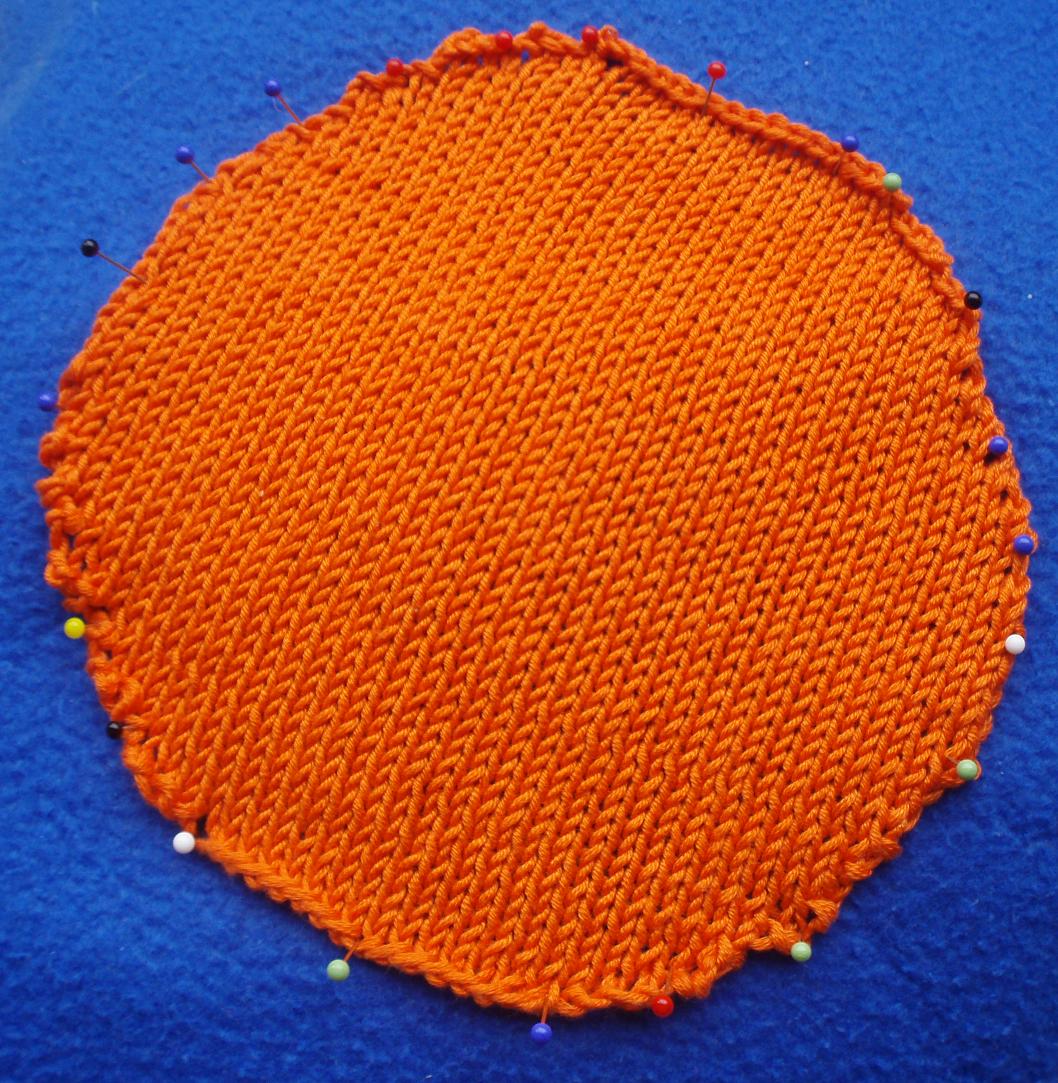
Apologies for the eyeball-searing colour. I think I’ve been half-blinded from the real thing. I’m using Katia Monaco which is 100% mercerised cotton in a DK weight. The ball band claims a tension of 22 sts x 27 rows over 10cm on 3.5mm needles.
So this is the equation to get the stitch count for a chosen row (n) given the radius and the gauge. This will give you a quarter circle. To get a semicircle, double the value.
Which reads
“The number of stitches on row n is the square root of the radius (measured in stitches) squared, minus (the radius (measured in rows) less this row number) squared, times the gauge squared.”
A little cumbersome, perhaps, but all you have to do is plug in the numbers. With this yarn, for example, I wanted to get a 7″ Φ circle (17.7cm) and or 0.81.
So the radius is 8.8cm which means
And
So to calculate the appropriate number of stitches for each row, I made a table. I rounded the values to the nearest integers. I doubt even Elizabeth Zimmerma’am could knit 14.36 stitches!
The cast-on value is different to the number of calculated stitches because I adjusted for only casting on extra stitches at the start of each row. Note this is stockingette, so every even row is purled. Once you get to the end, work back down the rows, casting off instead of casting on stitches till you get to the last row and cast off the remaining 16.
| Row | Calculated stitches | Stitches to cast-on at the start of this row |
|---|---|---|
| 1 | 14 | 16 |
| 2 | 18 | 3 |
| 3 | 20 | 3 |
| 4 | 24 | 3 |
| 5 | 26 | 2 |
| 6 | 28 | 1 |
| 7 | 28 | 1 |
| 8 | 30 | 2 |
| 9 | 32 | 1 |
| 10 | 32 | 1 |
| 11 | 34 | 1 |
| 12 | 34 | 1 |
| 13 | 36 | 1 |
| 14 | 36 | 1 |
| 15 | 38 | 1 |
| 16 | 38 | 0 |
| 17 | 38 | 0 |
| 18 | 38 | 1 |
| 19 | 40 | 1 |
| 20 | 40 | 0 |
| 21 | 40 | 0 |
| 22 | 40 | 0 |
| 23 | 40 | 0 |
| 24 | 40 | 0 |
Many, many thanks to codecogs for their great free online equation editor
Who’da thunk I’d do so much trig “just knitting”. Trying to remember all my circle functions.
Been reading lotsa wikipedia. We have tons of algebra books at home, but no dedicated trig. S’pose it’s all the same in the end!
I had totally forgotten this gem

As Mr. Keane used to say:
“Two Old Angels Skipped Over Heaven Carrying A…
…Heineken!”
Check out my other mathematical knitting blog posts
 Catchloops